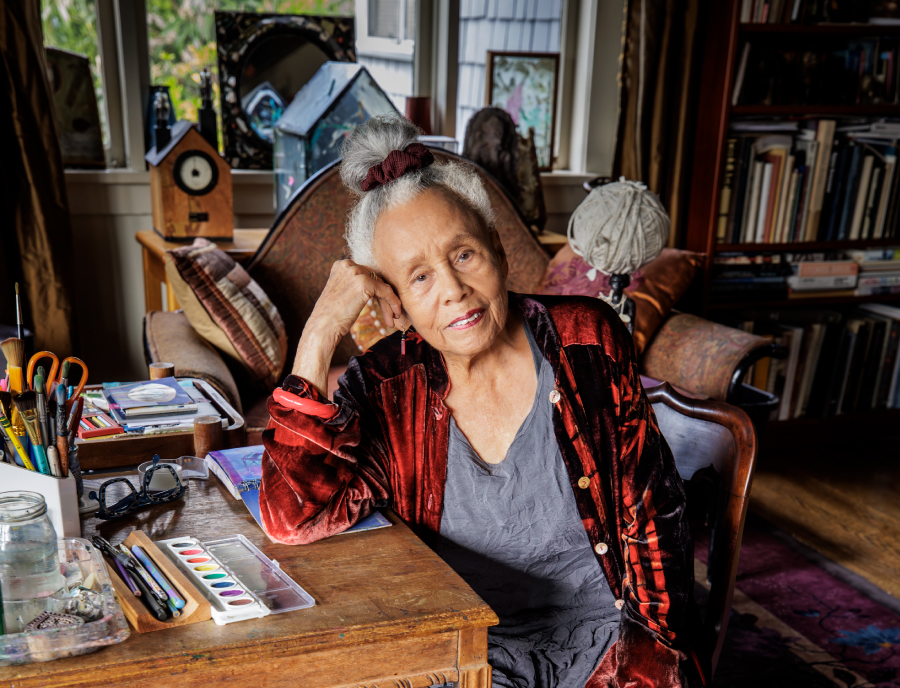
Saar taught at Otis College in the 1970s and 1980s and was awarded an honorary doctorate from the College in 1992.
I don’t know where I saw it, but Betye Saar’s Liberation of Aunt Jemima (1972) affected me as a child. I collected dolls from different regions and historical periods, and of course, I knew the character of Aunt Jemima from the pancake syrup. Saar’s Liberation of Aunt Jemima gave me a way forward, a way to understand why dolls intrigued me and freed me to think that dolls are not just kid stuff. They are pint-sized representations of power and control. Worth considering, with a shudder. I looked at my dolls, a Bermudian Black cop dressed like a British bobby in short pants, a Jamaican woman with a fruit basket on her head, an “Eskimo” fisher dressed in “real fur,” in a different light.
Betye Saar, along with Frida Kahlo, raised in my young mind a question I still ask: What is culture, who creates it, and by what means is it transmitted?
Saar both created culture and transmitted it. Stories are one means; Betye Saar was a storyteller and a self-described spiritual person who, like most artists, believed in efficacy, the power of things. She saw the power of things, ordinary things, and the power of art. She changed things with her methods of assemblage, giving them a new magic. She used the word “magic,” and I admired her for it. Art is about belief.
In contrast to stock racist characters like the eponymous mammy, she told the story of her Aunt Hattie, an inspirational person who was central in Saar’s life. She created her well-known work Record for Hattie as a reliquary of her aunt’s energy and importance. Saar herself became a legendary figure to generations of artists, not only to her many students at Otis College of Art and Design and elsewhere, but more generally.
Echoes of Saar’s approach can be seen in the work of countless artists. Lauren Halsey’s recent Untitled 2026, a sphinx, ten-feet long and rooted in both ancient Egypt and South-Central L.A., feels indebted to Saar. Halsey takes the old monument and fills it with her own references, her own neighborhood, and, like Saar, re-centers a story that has always been there.
Betye Saar’s work is both a project of reclamation and transformation, making it tell richer, more complex stories. She was an acclaimed artist; an acclaimed Black female artist; the matriarch of a revered family of artists and writers, Lezley, Alison (’81 MFA Fine Arts), and Tracye Saar-Cavanaugh; and one credited as the founder of an entire movement in the arts: Angela Davis credited The Liberation of Aunt Jemima with launching the Black women’s movement. I can’t think of another artist for whom one could make all four claims.
Artist and Otis alumna Patsy Pitts (’18 BFA Fine Arts, ’24 MFA Fine Arts), who once made a large-sized ceramic work with the figure of Sojourner Truth seated like Lincoln in his memorial, states:
“Betye Saar deserves a unique contemplation. She taught us to look at the ground as the black raven’s shadow brings us to Jim Crow. Schemes shatter with the insaneness of a handless clock. It asks us to take another look at who we are. Great carvings in the mountaintops are painted by imaginary strokes, installed in practical boxes, and displayed as narratives to consider in her work. Aunt Jemima’s red lips laugh, shift as she holds a weapon. History we choose to forget cannot run away. These are some of the glimpses that come to mind as one remembers Betye Saar, a vessel fulfilling legacy at Otis College of Art and Design and throughout our world.
Alumni and students are given the mastery of tactile ingenuity that can only be perceived by the heart. In our corridors, along with other great Afro-American artists such as Charles White, Kerry James Marshall, David Hammons, Michael Massenburg, to name a few, become a part of us. ‘If I could touch the hem of His garment…’ Matthew 9:20–22 speaks to a belief in shared equity through the presence of greatness. It is invaluable to stand upon such remarkable shoulders. Moreover, her passing is a call to pick up our sword. Artists are equipped to sever injustices and reveal the nakedness of humanity with a stroke of a brush. This should never be budgeted away or taken for granted.
Digital numbness can dull inclusion. We have to go outside and perceive our surroundings, walking alone to gather ammunition to equip our future with compassion, accountability, and joy. As we mourn this great loss, let us continue at Otis to hold the banner high and commit to being more than lines on a page, but keepers of the heart.”
In the legacy of Betye Saar, and in the work of artists like Lauren Halsey, David Hammons, and Michael Massenburg, we find a living tradition, one that asks us to reimagine who we are, what we inherit, and how we move forward. Their art insists on presence, on justice, on the kind of community that can only be built when we remember, reshape, and reclaim our stories.
Read More from Otis College on Betye Saar’s passing.
Learn about the Fine Arts program at Otis.
Related News


Where Otis College Students Find Inspiration in Los Angeles
October 09, 2026
From Gaming Together at Otis College to Building a Business
September 30, 2026